I do not believe in dashboards that flatter. I believe in numbers that bother me just enough to change something the following week.
That is exactly what "Your week in review" does in Singularity: a weekly recap that opens on its own and tells me, plainly, what I shipped, how I shipped it, and what it cost. Not to give me a grade. To give me a direction.
Why gamify a developer's work
Gamification has a bad reputation because it has too often been reduced to useless badges. Here the idea is the opposite: not to reward activity, but to make progress visible. A developer who watches their curve improve changes their behaviour on their own — no manager looking over their shoulder, no imposed target.
Singularity does not ask me to "do more". It shows me what "better" means, with numbers, and lets me draw my own conclusions.
Ship more, but ship better
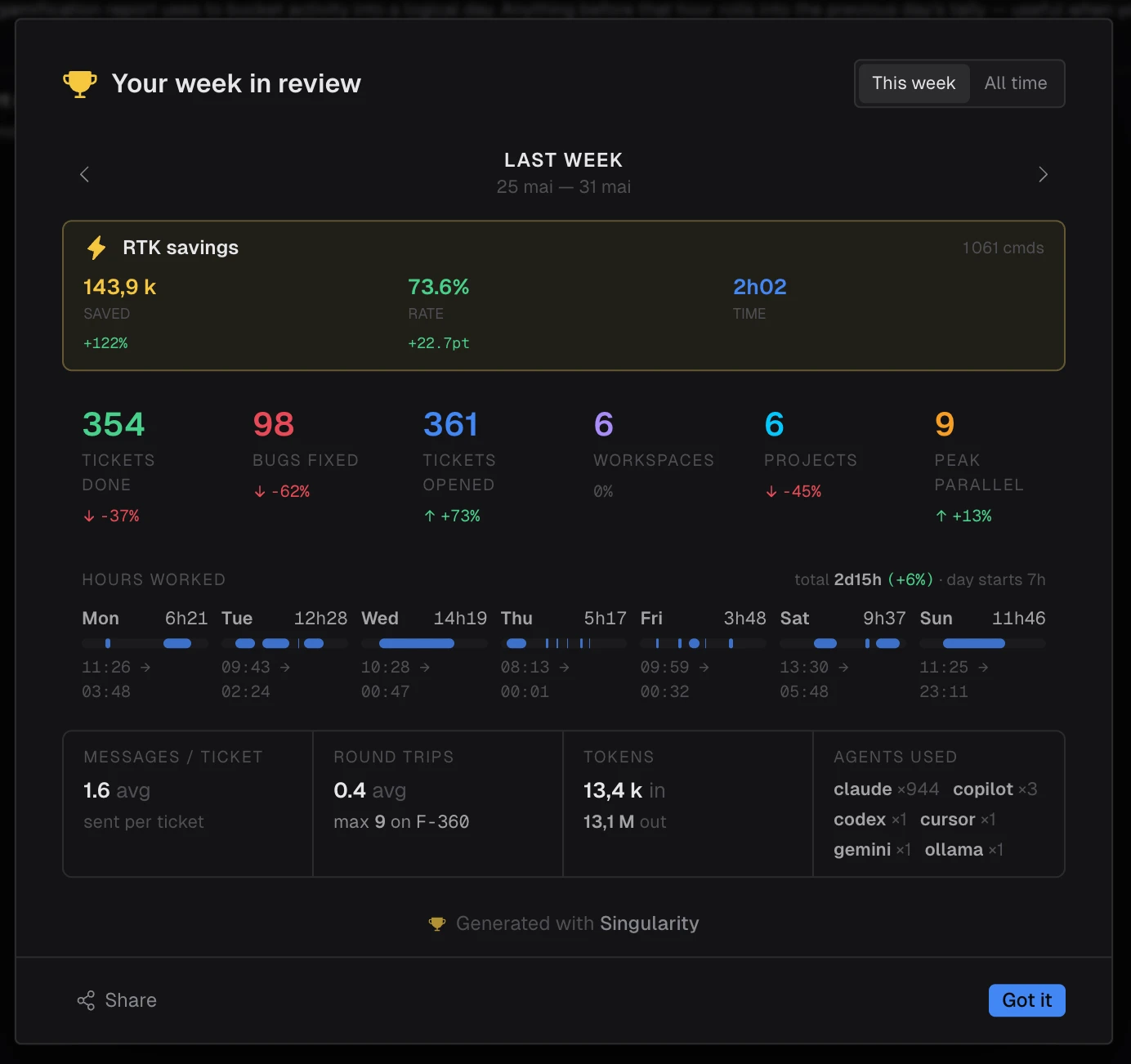
The week above tells a precise story. 361 tickets opened (+73%), but only 98 bugs fixed (−62%). At first glance you might think I am fixing less. The truth is the opposite: I keep opening more feature tickets and fewer bug tickets.
Fewer bugs to fix is not less work: it is the sign of a codebase getting healthier. Singularity's gamification puts that trend in black and white, week after week, where we usually only "sense" it vaguely.
That is what "ship more but ship better" means: the amount of value delivered rises while the amount of debt we have to mop up falls.
The metric that tells the truth: how often I reopen a ticket
Of all the stats on the screen, the one I look at first is the "round trips": how many times I reopen a ticket to push it forward. This week, 0.4 round trips on average, with a peak of 9 on ticket F-360.
A ticket reopened nine times is not an AI that failed nine times. It is a task I scoped badly: fuzzy boundaries, vague acceptance criteria, missing context. The round trip is the most honest mirror of my own upstream rigour. The sharper my ticket, the less I have to come back to it.
The average messages per ticket (1.6) says the same thing from another angle: a well-framed ticket resolves in one pass, not in an endless conversation.
Everything counts: agents, tasks, and tokens saved
The recap is not limited to "what I did". It also counts who did it: over the week, Claude was called 944 times, ahead of Copilot, Codex, Cursor, Gemini and a local Ollama model. Seeing the real split between agents means understanding where each AI is most useful — and stopping sending everything to the same model out of habit.
And then there is the line I care about most: RTK savings. RTK (Rust Token Killer) filters the verbose output of commands before it reaches the model. In this single week: 143.9k tokens saved, a 73.6% savings rate, across 1,061 commands. Tokens I did not pay for, context I did not pollute, and an agent that stays focused on what matters.
When you orchestrate several AIs in parallel all day — here up to 9 concurrent tasks at peak — that kind of saving is not a detail. It is the difference between a workshop that scales and a bill that explodes.
Continuous improvement: for me, for Singularity, for everyone
This recap has three readers.
Me first. I see where I scatter my focus, which tickets I scope badly, which hours I actually work. I fix it the following week.
Singularity next. These metrics feed the product: if a type of ticket systematically generates round trips, that is a signal to improve automatic ticket enrichment or agent profiles.
Everyone, finally. Each user who improves makes the tool better for the next one. It is a virtuous loop: measure, understand, adjust, repeat. Gamification is just the engine that keeps that loop turning without us having to think about it.
Frequently asked questions
What is "Your week in review" in Singularity?
It is an automatic weekly recap of your development activity: tickets done, bugs fixed, tickets opened, hours worked, round trips per ticket, tokens consumed, AI agents used and RTK savings. It opens on its own to make your progress visible effortlessly.
What does the "round trips" metric measure?
It counts how many times you reopen the same ticket to push it forward. A high number usually signals a poorly scoped ticket (fuzzy boundaries, vague criteria) rather than an AI failure. It is an indicator of your upstream framing quality.
What are RTK savings?
RTK (Rust Token Killer) filters the verbose output of commands (builds, tests, git, etc.) before it reaches the model. The recap shows tokens saved, the savings rate and the number of filtered commands over the week — often a 60 to 90% reduction on common operations.
Does gamification impose productivity targets?
No. Singularity sets no quota. The recap makes progress visible and lets each person draw their own conclusions. The goal is continuous improvement, not numeric pressure.